
It is Thursday afternoon, and a performance marketing lead named Sarah has a problem. She has four distinct ad sets ready to go for a new SaaS product launch, but the creative assets are stalling. The creative team is backlogged with high-fidelity brand videos, and the stock photo libraries are looking increasingly like a relic of 2014. She needs forty unique variations—different aspect ratios, color palettes, and demographic-specific hero images—by tomorrow morning. In the old world, this was a recipe for burnout or a compromised launch. In the current landscape, Sarah turns to high-velocity workflows.
The bottleneck in modern digital marketing isn’t usually the strategy or even the copywriting; it is the speed of creative production. We are in an era where “creative fatigue” happens in days, not months. Platforms like Meta and TikTok demand a constant stream of fresh visuals to keep acquisition costs low. This is where the tactical application of generative tools changes the math of a campaign.
The Iteration Trap in Performance Marketing
Most marketing teams are stuck in an “iteration trap.” They spend 80% of their time on a single “perfect” asset, only to find it underperforms in the first 24 hours of a live spend. When the need for 50+ ad variations per week becomes the standard, the traditional pipeline breaks. You cannot wait three days for a retouching cycle when the algorithm needs fresh data points now.
The cost of “safe” stock imagery is often hidden in lower click-through rates. Audiences have developed a sixth sense for generic office settings and forced smiles. On the flip side, unpolished generative art carries its own risks—odd limb placements or surreal textures that can alienate a professional audience. The goal is to move from a “one-and-done” mindset to a continuous experimentation loop, where you are generating, testing, and refining in a matter of hours.
Architecting the Campaign: When to Deploy Nano Banana
Within a professional workflow, not every model serves the same purpose. You wouldn’t use a heavy, slow-rendering cinematic model to test twenty different background colors for a social media “thumb-stopper.” This is where Nano Banana finds its specific utility. It functions as the high-cadence driver for rapid visual prototyping.
While high-resolution models like Gemini 3 Pro are excellent for landing page hero images that require extreme detail, the strength of a lighter, faster engine lies in volume. When you are building assets for the “top of the funnel,” you are looking for a specific vibe or composition that stops the scroll. You can generate a dozen variations of a “modern minimalist workspace with neon accents” in the time it takes to brew a cup of coffee.
This speed allows a marketer to bridge the gap between a high-level creative brief and platform-specific reality. Instead of guessing if a purple or blue color scheme will convert better on Instagram Stories, you generate both sets instantly. It is worth noting, however, a moment of limitation: while speed is a massive advantage, these high-velocity models may occasionally sacrifice the extreme textual accuracy found in larger, slower counterparts. For assets where every pixel of a specific product label must be legible, a multi-stage process involving an AI Photo Editor is usually required.
The Workflow: From Raw Prompt to Multi-Channel Asset
A cohesive campaign requires a visual thread that connects a Facebook ad to a landing page to a follow-up email. Disjointed visuals create friction in the customer journey. Using Banana AI as a centralized hub allows creators to maintain that thread across different models and generations.
The workflow typically begins with a “master prompt” that defines the brand’s aesthetic—lighting, texture, and mood. Once the core concept is validated, the process of prompt chaining begins. Here is how a standard sequence might look:
- Core Generation: Define the central subject (e.g., “A professional woman using a tablet in a bright, glass-walled office”).
- Format Adaptation: Using the same seed or stylistic parameters to generate square (1:1) versions for Instagram feeds, vertical (9:16) for Reels, and horizontal (16:9) for YouTube or LinkedIn.
- Refinement: Identifying the “winners” and running them through an AI Image Editor to adjust contrast, remove distracting background elements, or enhance lighting to match the brand’s specific hex codes.
By keeping the generation process within an integrated ecosystem, you reduce the “style drift” that occurs when jumping between different standalone tools. Integrating these AI-generated visuals into a final template in Figma or Canva adds the necessary brand layer—logos, CTA buttons, and UI overlays—that moves the asset from “cool art” to “performing ad.”
Beyond the Generator: Refinement and Logical Constraints
No matter how advanced the underlying models become, they are not a “set and forget” solution. The “uncanny valley” remains a very real threat in performance marketing. If a potential customer sees a hand with six fingers or a face with asymmetrical features, the trust in the brand evaporates instantly. This is a point of necessary human oversight: the creative director’s eye is more important than ever.
There is also a significant level of uncertainty in predicting which AI-generated styles will actually resonate. We often assume a hyper-realistic photo will perform best, but sometimes a stylized, almost “claymation” or “3D render” aesthetic (which models like Gemini 3.1 Flash can produce with ease) ends up outperforming the realistic option in A/B tests.
Marketers must also be cautious about brand-safe compositions. An AI might generate a stunning visual that technically violates a platform’s advertising policies or contains subtle background elements that contradict a brand’s values. Automated scaling cannot yet replace the judgment required to ensure every asset is fit for public consumption. You are not just looking for a “good” image; you are looking for an image that fulfills a specific strategic intent.
Bridging Video and Stills for Full-Funnel Coverage
Static images are the foundation, but video is the current king of engagement. A holistic campaign asset pipeline should include a transition from stills to motion. The logic here is “test in static, scale in video.” It is far cheaper and faster to test a visual concept with ten static images than to render ten different 15-second videos.
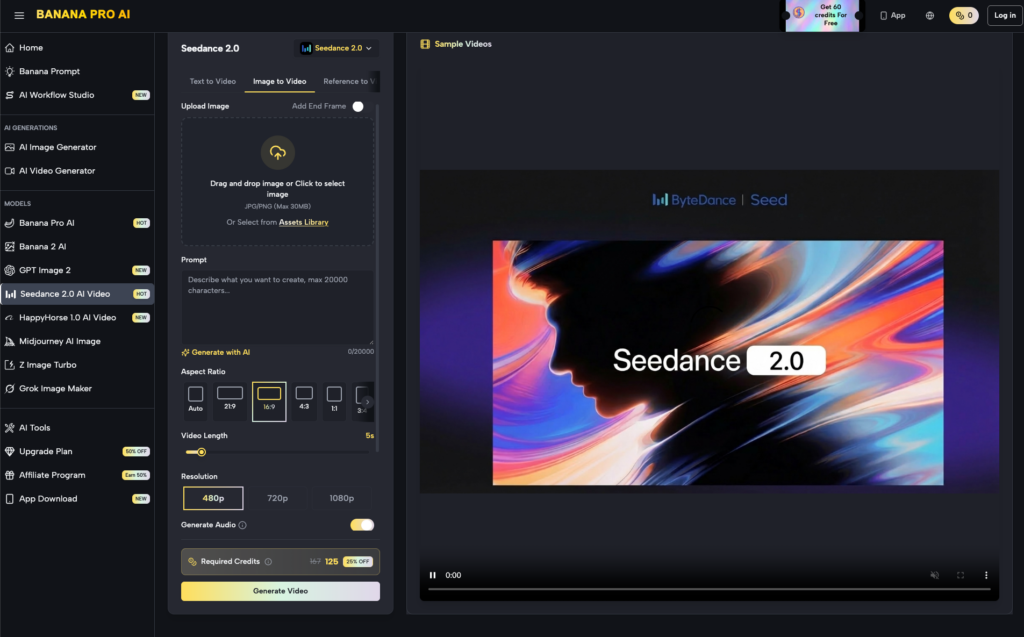
Once a specific visual style or subject is proven to have a high click-through rate, you can move those assets into video models like Seedance 2.0 or Gemini Omni. This allows you to animate a successful static hero image, adding subtle motion like floating particles, camera pans, or character movements that draw the eye without requiring a full production crew.
The ROI of this AI-assisted production is measured in “speed to insight.” If it takes you three weeks to produce a video for a concept that ends up failing, that is three weeks of wasted budget. If you can validate the concept in three hours with a static image and then generate a supporting video in an afternoon, you have shortened your learning curve significantly.
In the end, tools like Nano Banana aren’t just about replacing designers; they are about liberating them from the repetitive, soul-crushing task of resizing and versioning. It allows the creative team to focus on the high-level conceptual work while the AI handles the heavy lifting of volume. As the digital landscape becomes more crowded, the winners will be those who can iterate the fastest without losing their brand’s soul in the process. We must accept that while the AI provides the raw material, the human provides the meaning—and that balance is exactly where the best marketing lives.