
The current discourse around generative AI is heavily skewed toward the “mirage of the perfect prompt.” In this idealized version of the creative process, a creator feeds a carefully constructed string of tokens into a black box and receives a production-ready asset in return. For indie makers and marketers, this is a seductive narrative because it promises a collapse of the labor-time required to move from concept to execution.
However, anyone who has actually tried to use AI-generated images for a product launch or a high-fidelity marketing campaign knows that the “one-shot” output is a statistical anomaly. The reality of professional creation is that the initial generation is merely the raw material. The true bottleneck—and the real metric of a tool’s utility—is not how well it interprets a prompt, but how easily that output can be refined, corrected, and integrated into a final design. For creators building repeatable pipelines, the primary evaluation criterion should be the seamlessness of the post-generation refinement process.
The Statistical Improbability of the Perfect Raw Output
The industry’s obsession with text-to-image prompts ignores a fundamental truth of stochastic models: they are built on probability, not intent. Even with advanced models like Flux or Seedream, the model has no “understanding” of the physical world or the specific brand requirements of a project. It is simply predicting the next most likely arrangement of pixels based on its training data.
This leads to the “uncanny valley” of professional assets. An image might be 95% perfect, but the remaining 5% contains a technical hallucination—a mangled limb, a background element that defies gravity, or lighting that contradicts the rest of the scene. In a prompt-only workflow, the typical response to these errors is “re-rolling.” The creator hits generate again, hoping for a better result.
This is a low-yield strategy. Re-rolling is essentially a gamble that costs time and, in many cases, GPU credits. More importantly, it discards the 95% of the image that was correct. For an indie maker working on a tight deadline, the ability to target that specific 5% error with a precision tool is far more valuable than the ability to generate a thousand new random variations.
Evaluating Workflow Friction and the Refinement Bottleneck
When evaluating an AI workflow, the biggest hidden cost is “data egress.” This refers to the friction of moving an asset between disparate platforms. If you generate an image in one tool, download it, and then upload it to a legacy image editor to fix a mistake, you are losing more than just seconds of time. You are often losing metadata, fidelity, and the iterative “feedback loop” that makes AI creative work efficient.
The “Last Mile” problem in AI media is where 90% of the image is ready but the final 10% requires specific, non-stochastic control. This is where most workflows break down. Traditional editors are often too heavy-handed for quick AI fixes, while basic generative tools lack the granular control needed for professional work.
A consolidated AI Photo Editor environment stabilizes the creative cycle. By keeping the generation (using models like Nano Banana or Flux) and the correction tools (like object removal or upscaling) in a single interface, the creator reduces the cognitive load of context switching. It is currently uncertain whether integrated platforms will ever fully replace the high-end utility of desktop software for complex compositing, but for the vast majority of web-based assets, the integrated approach is becoming the standard for speed.
Technical Benchmarks for Professional-Grade Editing
What should a creator actually look for in an AI Photo Editor? It isn’t just about having an “enhance” button. Professional-grade editing requires regional control.
Global prompts—those that affect the entire image—are useless for fixing a specific reflection on a pair of glasses or removing a stray passerby from a street scene. A robust tool must offer:
- Granular Object Erasure: The ability to remove elements without creating a visible “smudge” or texture repetition that screams “AI-edited.”
- Character and Face Consistency: Features like Face Swap are often dismissed as gimmicks, but for a creator building a brand, the ability to swap a generic AI face for a consistent brand persona across different scenes is a massive technical hurdle cleared.
- Regional In-painting: Replacing a specific section of an image (like changing the color of a shirt) while maintaining the lighting and shadows of the original generation.
We must acknowledge a current limitation: AI still struggles with complex physical logic. For example, if you ask an editor to fix a hand that has six fingers, the generative fill may still struggle with the anatomical intersection where the fingers meet the palm. These are areas where the technology is still maturing, and creators should expect to occasionally hit a wall where even the best AI tools require manual “pixel pushing.”
The Economics of Prompting vs. Targeted Refinement
From a commercial perspective, the “prompt until it’s perfect” method is a drain on resources. If you are using a platform that charges per generation, twenty re-rolls to fix a minor background detail is a waste of capital.
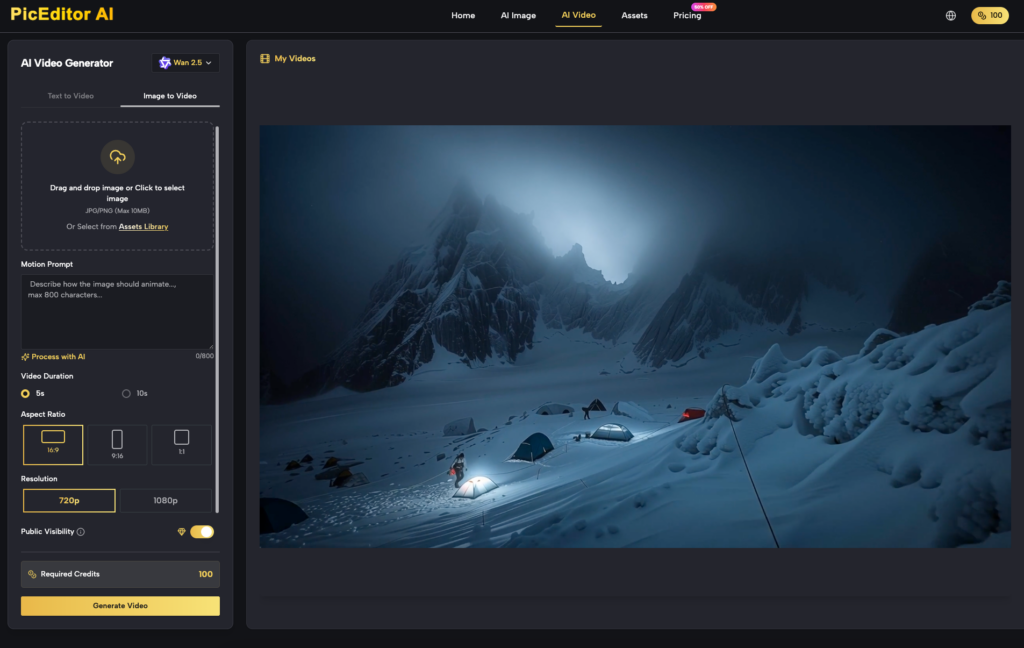
Shifting the creative burden from linguistic precision (prompting) to visual selection (editing) is a more scalable model for high-volume work. Platforms like PicEditor AI allow users to leverage diverse models—such as Nano Banana for efficiency or Flux for high-fidelity realism—and then move those outputs directly into Photo Edit suite.
This modular workflow reduces “prompt fatigue.” The creator no longer has to become a professional linguist to get the desired result. They can generate a “good enough” base and then use targeted tools to polish it into a “perfect” final asset. This approach is significantly faster for launching product pages or social media ad sets where the volume of assets required is high, but the tolerance for visual errors is low.
Building a Model-Agnostic Creative Pipeline
One of the greatest risks for indie creators is becoming overly reliant on the specific “look” of a single model. Models like Midjourney or Stable Diffusion have distinct aesthetic biases. If a creator’s entire workflow is built around the idiosyncrasies of one prompt engine, they are vulnerable when that model’s pricing changes or its aesthetic becomes dated.
A professional pipeline should be model-agnostic. The goal is to master the logic of asset refinement rather than the “magic words” of a specific generator. Whether the source image comes from a text-to-image prompt, an image-to-image transformation, or even a frame pulled from an AI video tool like Kling or Wan, the editing stage remains the constant quality-control layer.
However, a necessary expectation-reset is required: No amount of AI-driven editing can currently replace a fundamental misunderstanding of composition or lighting in the source prompt. If the base image is poorly framed or the lighting is fundamentally flat, “enhancing” it will only result in a higher-resolution version of a bad image. The editor is a force multiplier, not a miracle worker.
In the next era of digital creation, the winners won’t be the people who can write the longest prompts. They will be the operators who can take a raw, imperfect AI output and efficiently refine it into a professional asset using a streamlined, integrated toolset. Focus on the editability of your pipeline; it is the only way to move from “playing with AI” to “producing with AI.”